
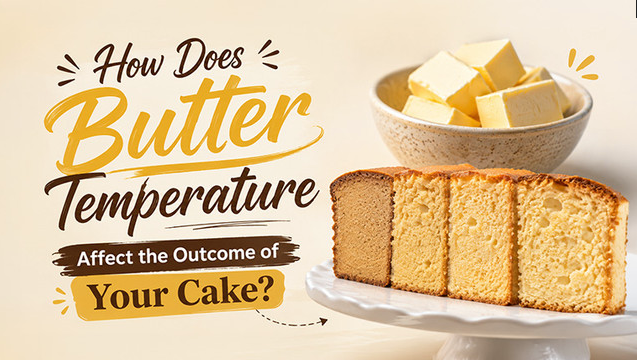
Someone follows a recipe exactly, weighs every ingredient, sets the oven to the right temperature, and the cake still comes out dense in the middle or slightly greasy at the edges. Nothing about the method looks wrong on paper.
The missing detail, more often than not, is butter temperature, and it rarely gets more than a passing mention in most recipes, even though it quietly decides how a cake rises, how fine its crumb turns out, and how it holds together once cooled. This is one of the first things covered properly in any serious baking courses in Chennai, simply because so many home bakers run into the same problem without ever knowing why.
In short, butter that’s too cold won’t trap air properly, butter that’s too warm collapses that air before the batter even reaches the oven, and the narrow window in between is where good cakes actually happen.
Why Butter Temperature Isn’t Just a Small Detail
Butter plays two roles in a cake batter. It carries flavour, and it holds air. When butter is creamed with sugar at the right temperature, sugar crystals cut tiny air pockets into the fat, and those pockets expand once heat hits them in the oven.
That expansion is a large part of what gives a cake its lift. Get the temperature wrong, and that entire mechanism either underperforms or fails outright, regardless of how good the recipe itself is.
What Happens When Butter Is Too Cold
Cold butter, straight from the fridge, doesn’t cream properly. It stays in stiff little lumps instead of blending smoothly with sugar, and the air pockets that should form simply don’t. The result is often a cake that looks fine going into the oven but comes out dense, with an uneven crumb and patches that feel slightly heavier than the rest.
Some bakers assume this means they didn’t mix long enough, so they keep beating the batter, which usually makes the texture worse rather than better.
What Happens When Butter Is Too Warm
The opposite problem is just as common, and arguably harder to notice in the moment. Butter that’s gone soft, or worse, partially melted, can’t hold its structure. It creams quickly and looks deceptively good, but the air bubbles it traps are unstable and collapse before baking even begins. Cakes made this way often sink slightly in the centre or spread more than expected, since the batter is essentially too loose to support itself.
The Narrow Window That Actually Works
The ideal range sits somewhere around room temperature, soft enough to leave a slight indent when pressed, but still holding its shape rather than sliding or shining with melted fat. It sounds like a small distinction, and in a way it is, but it’s also the difference between a cake that rises evenly and one that doesn’t.
This is exactly the kind of detail that’s difficult to gauge from a written recipe alone, since “room temperature” changes depending on the kitchen, the season, and even the butter’s fat content.
Why This Trips Up Even Careful Bakers
It’s worth acknowledging that this isn’t really about carelessness. Most people baking at home are following instructions closely, sometimes more closely than they need to. The issue is that butter temperature isn’t something a recipe can fully explain in a sentence. It has to be felt, seen, and corrected in the moment, which is hard to learn from a photo or a paragraph of instructions.
Understanding that this is a skill, not a shortcut someone forgot to mention, tends to remove a lot of the frustration that comes with repeated failed bakes.
How Climate and Season Change the Equation
Butter behaves differently depending on the room it’s in, which is easy to overlook when following a recipe written for a different climate.
In warmer, more humid conditions, butter softens faster than a recipe’s stated resting time might account for, meaning twenty minutes on the counter could already be too long. In cooler weather, that same twenty minutes might not be enough.
In a city with distinct seasonal differences in kitchen temperature, learning to judge readiness by feel rather than by the clock is key.
Adjusting for Different Cake Styles
Not every cake wants the same butter temperature either. A dense pound cake benefits from butter creamed longer at a slightly cooler range, since it relies less on trapped air and more on structure. A light sponge, on the other hand, needs butter closer to the softer end of room temperature to whip in enough air for that delicate rise. Recognising which category a recipe falls into, and adjusting accordingly, is part of what separates a cake that turns out well once from one that turns out well consistently.
A Skill Worth Practicing Deliberately
None of this is complicated in theory, but it’s really difficult to internalise without repetition and feedback. Pressing a thumb into butter and knowing, almost instantly, whether it’s ready, is a skill built through practice rather than instruction alone. It’s part of why hands on learning tends to close this gap faster than recipes ever can.
Zeroin Academy’s baking classes in Anna Nagar spend real time on exactly this kind of foundational technique, the sort of thing that doesn’t show up as a headline in a recipe but ends up shaping every cake a person bakes afterward.
So the next time a cake comes out denser than expected, or sinks slightly despite a careful method, it’s worth going back to that first, easy to overlook variable. Not the oven, not the flour, but the butter, and whether it was ever really at the temperature the recipe assumed it was.

